

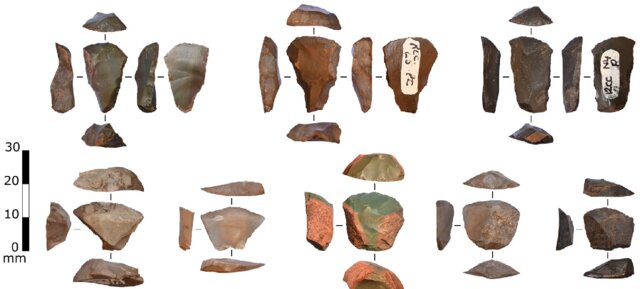
Rose Cottage Cave is widely recognised as a key sequence for the Middle Stone Age and Later Stone Age in the southern African central interior, with its unique palaeoenvironmental and chrono-cultural archive spanning a semi-continuous record from the Late Pleistocene to the 19th century. Building on important previous research, new excavations will extend our knowledge concerning technological systems, landscape use, human-environment interactions, as well as site formation and the linkages between these parameters in a regional context. Here we report on preliminary insights from the recent fieldwork and provide an overview of future directions.
Typologie d'actualités : Publications
Article | Macchia or forest? Toward the reconstruction of Ericaceae formations in Corsica (NW Mediterranean) during the Holocene using a quantitative wood anatomy analysis
Source : https://doi.org/10.1016/j.jasrep.2025.105014
Arbutus unedo L. is very abundant in pre- and protohistoric anthracological assemblages of Corsica (north-western Mediterranean). In the present day, it is a dominant species, along with Erica arborea L., of the macchia, a shrubland ecosystem that covers a major part of the island. The current state of the macchia is characterised by a low and more or less dense shrubby stage, maintained by frequent disturbances. However, rare preserved plots demonstrate the capacity of Arbutus unedo to evolve into a tree up to 10 m high, forming high, nearly forested macchia.
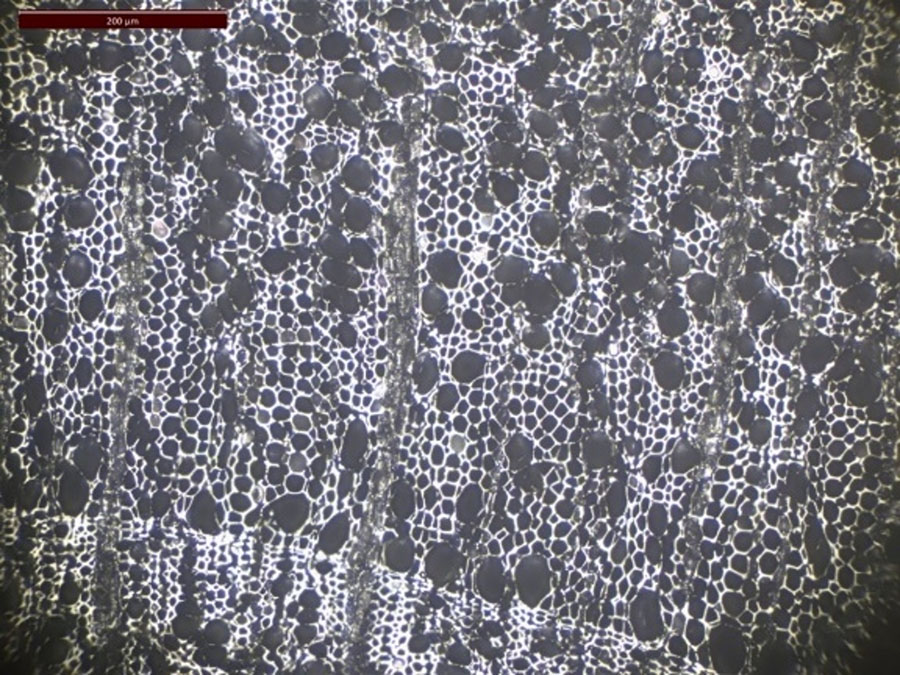
A traditional anthracological approach documents the floristic composition of past woodland but it does not allow us to specify the growth habit of the trees. Consequently, the physiognomy and structure of the Holocene Ericaceae formations remain unknown, despite their abundance in the landscape and their potential for exploitation in pre- and protohistoric human activities. To address this issue, we have developed a quantitative eco-anatomical approach for the characterisation of size patterns of Arbutus unedo. This method is based on the measurement and quantification of wood structural and vascular elements whose abundance and size are influenced by natural or anthropogenic ecological parameters. Modern wood samples are used to build a predictive model that can be applied to archaeological specimens.
Results from statistical analyses indicate that tree height and branch size are recorded by eco-anatomical features. Moreover, it has been shown that tree height is correlated with anatomical features such as ray size and vessel density. Applied to archaeological samples of Arbutus, the eco-anatomical analysis highlights the presence of tall Arbutustrees during the early Neolithic period, while low macchia appears to be the dominant vegetation type during the Bronze and Iron Ages. These results confirm hypotheses previously formulated from pollen and charcoal data and provide further insight into the impact of human activities on the landscapes.
Ouvrage | Circulations animales et zoogéographie en Méditerranée (Xe siècle av. J.-C.-Ier siècle apr. J.-C.)

Source : https://doi.org/10.4000/12wei
L’histoire des circulations en Méditerranée ancienne s’est longtemps restreinte à celles des hommes et dans le cadre des milieux anthropisés, au détriment des circulations des animaux. L’essor des études animales amène désormais à les intégrer pleinement à cette histoire qui s’insère aussi dans celle des environnements et des sociétés qui les habitent.
Au cours du Ier millénaire av. J.-C., des espèces ont régressé sous la pression humaine (lions, éléphants), voire disparu ; d’autres sont arrivées…
Article | The King and Queen of France Keep Separate Accounts Marguerite de Provence, Finance and the Separation of Royal Households (1261).
Source : https://www.jstor.org/stable/27343493
“The king and queen of France keep separate accounts”: if the separation of the king and the queen as the usual mode of life of a princely couple is well recorded in the Late Middle Ages, what was it like in the thirteenth century, at the time of the emergence of the hôtel réginal (the queen’s household)? The issue of royal institutions and entourage has received renewed attention in recent years, but little note has been taken of the hôtel réginal. The appearance of the queen’s household in the French kingdom should perhaps be situated in a much more political context than historians have led us to think. Indeed, the study of the personality of Marguerite of Provence (1221-1295) suggests that some interesting reflections can be raised in this connection. This article will also explore the chronology of the institutional appearance of Marguerite de Provence’s household independently of that of the king, and will show that she was probably the first queen in western Europe to have one.
Article | Potential and limitations of adhesive identification on museum curated metal objects

Source : https://doi.org/10.1016/j.culher.2024.12.013
In Europe, adhesives were produced and employed from the Middle Palaeolithic onwards. In the earlier periods, adhesives were used predominantly for hafting tools and weapons, but their functionality evolved with the advent of ceramic technologies, with use widening to pottery repair and ornamentation. Limited attention has been directed towards their application in metalwork. It is unclear whether the scarcity of adhesives described in association with metal is due to preservation factors, such as corrosion-related issues, or to a research emphasis on other materials associated with metalwork such as coral, amber, and glass. To address this issue, we conducted chemical analyses including gas chromatography – mass spectrometry on 18 adhesive residues present on 15 objects from France and England dated from the mid first millennium BCE to the first century CE. These artefacts include jewellery, vessels, harness fittings and weaponry components. Our findings suggest that a range of adhesives were employed in assembling and applying decoration to diverse types of metal objects. These include birch tar and conifer resins, also bitumen and possibly beeswax, which have not been reported before. However, the application of waxes in past conservation practices introduces challenges that can potentially constrain the interpretation of molecular analyses. Our results have implications for the understanding of the adhesive technologies, and illustrate the potential of identifying adhesives linked to metal ornamentation. They further demonstrate the widening application of long-established adhesive technologies within the framework of increasingly complex craft specialisms.
Ouvrage | La réception du « Marius » de Plutarque dans les communautés culturelles de l’Empire romain
Source : https://hdl.handle.net/11572/441087
Questo volume tratta della ricezione, dal II al V secolo d.C., del Marius, biografia presente nelle Vite Parallele di Plutarco. L’obiettivo che si pone è duplice: da un lato, comprendere come questa opera abbia caratterizzato l’immagine di Gaio Mario; dall’altro, capire come il testo sia stato riusato dagli autori successivi, introducendo, negli studi sulla ricezione dei classici, il concetto di ‘comunità culturale’: una collettività coesa di intellettuali che riadatta i classici secondo i propri principi, mossa da obiettivi stilistici, politici e religiosi; un gruppo che ricostruisce il proprio passato per affermare il proprio pensiero, che propone come dominante. Esempi di questa dinamica saranno le riutilizzazioni della biografia in varie epoche: sotto gli Antonini si attualizza il messaggio etico del Marius; nel III secolo si esalta il volto autoritario del protagonista, in linea con l’atteggiamento dei Severi e degli ‘imperatori militari’. Nei secoli IV e V si riusa la Vita in due modi opposti: gli autori cristiani citano i passi in cui Mario è dipinto come un leader violento, mentre quelli pagani riprendono i capitoli in cui sembra un eroe, poiché i primi mirano a condannare la tradizione romana, i secondi a celebrarla.
Article | Viticulture in Iron Age and Roman southeastern France: A reconstruction based on charcoal and seed-fruit data compared to archaeological evidence and wine yields modelling,
Source : https://doi.org/10.1016/j.jasrep.2024.104952
Abstract: Winegrowing has dramatically shaped the landscapes as well as the culture and economy of societies in the Mediterranean region. It is generally accepted that it appeared and expanded in Mediterranean France during the Iron Age and the Roman period (ca 750 BCE − 500 CE). Viticulture flourished massively during the Early Roman Empire, when wine was widely exported throughout the Empire. The objective of this paper is to propose an updated overview of the history of viticulture based on a multidisciplinary survey combining archaeobotanical, archaeological data and modelling of wine potential yields. We aim to compare the information provided by seed-fruits and by charcoal, and to better understand how these data can be used to trace ancient viticulture in relation to other archaeological data. We collected and entered into a database all available results of charcoal and seed-fruit analyses from Mediterranean France and the middle Rhône valley. Seed and fruits provide evidence of fruit consumption and processing (table vs. pressing), while charcoal remains are stronger indicators of local cultivation. We also included published archaeological information about wineries and amphorae factories. This provides another way of identifying areas of cultivation and processing into wine, and gives hints on the scale of production and the possible destination for export. The reconstructions based on the multi-proxy information contained in the database are compared to the climate-vegetation LPJmL model estimates of wine potential yields and their variations over space and time. Charcoal and seed evidence concur to show that viticulture started in the 6th-5th c. BCE and developed with the progressive increase of potential wine yields throughout the Iron Age and then with the Roman Climatic Optimum. In the Roman period, the development of specialised winemaking facilities provides impressive evidence of viticulture, but is at the same time less favourable to its record by archaeobotany. Apparently, charcoals and seeds are more frequently preserved in rubbish assemblages when winemaking activities are still associated with domestic activities. While wineries and amphorae factories bear witness to a wine crisis in the Late Roman period, archaeobotanical remains indicate that viticulture persisted, probably in a less specialised mode, and modelling suggests that potential wine yields did not decline in comparison with the heyday of regional viticulture. Archaeobotany also provides consistent evidence of the existence of grapevine cultivation in urban Roman contexts.
Article | First evidence of early neolithic archery from Cueva de los Murciélagos (Albuñol, Granada) revealed through combined chemical and morphological analysis

Source : https://doi.org/10.1038/s41598-024-77224-w
The extraordinary preservation of Cueva de Los Murciélagos (Albuñol, Spain) provides a unique opportunity to identify the materials and the techniques involved in archery during the Early Neolithic period. Arrows with preserved feathers, tied fibres, adhesive substance, and two probable bowstrings have been studied trough an unprecedented multi-proxy investigation, including microscopy and biomolecular methods, to unravel archery techniques. The study has identified the oldest known sinew bowstrings, the first evidence for the use of olive tree (Olea europaea) and reed (Phragmites sp.) to produce arrow shafts in prehistoric European archery, and the identification of birch bark tar as a coating on the shafts. The results of this study provide insights into ancient craft, technological solutions, and adaptations to local resources in the production of these reed-shafted hardwood tipped arrows and bowstrings. Their deposition in a burial cave sheds new light on the role of these artefacts in a Neolithic farming community.
Article | 50-year seasonal variability in East African droughts and floods recorded in central Afar lake sediments (Ethiopia) and their connections with the El Niño–Southern Oscillation

Source : https://doi.org/10.5194/cp-20-1837-2024
Understanding past and present hydrosystem feedbacks to global ocean–atmospheric interactions represents one of the main challenges to preventing droughts, extreme events, and related human catastrophes in the face of global warming, especially in arid and semiarid environments. In eastern Africa, the El Niño–Southern Oscillation (ENSO) was identified as one of the primary drivers of precipitation variability affecting water availability. However, the northern East African Rift System (EARS) still suffers from the underrepresentation of predictive and ENSO teleconnection models because of the scarcity of local to regional historical or palaeo-data. In this paper, we provide a 50-year seasonal flood and drought chronicle of the Awash River catchment from the study of laminated sediment from Gemeri and Afambo lakes (central Afar region, Ethiopia) with the aim of reconstructing the magnitude of regional hydroclimatic events. Pluricentimetric micro-laminated lithogenic facies alternating with plurimillimetric carbonate-enriched facies are investigated in both lakes. We couple dating methods including radiocarbon, short-lived radionuclides, palaeomagnetic field variations, and varve counting on both lake deposits to build a high-resolution age model and to discuss the regional hydrosedimentary dynamics of the Awash River over the last 700 years with a focus on the last 50 years. Using a multiproxy approach, we observe that following a multicentennial enhanced hydrological period, the two lakes have experienced a gradual decrease in river load inflow since 1979 CE, attaining extreme drought and high evaporative conditions between 1991 and 1997 CE. In 2014, the construction of a dam and increased agricultural water management iin the lower Awash River plain impacted the erodibility of local soils and the hydrosedimentary balance of the lake basins, as evidenced by a disproportionate sediment accumulation rate.
Comparison of our quantitative reconstruction with (i) lake water surface evolution, (ii) the interannual Awash River flow rates, and (iii) the El Niño 3.4 model highlights the intermittent connections between ENSO sea surface temperature anomalies, regional droughts, and hydrological conditions in the northern EARS.
Article | High-precision 40Ar/39Ar dating of Australasian tektites associated with bifacial tools in the Bose Basin (Xiaomei and Fengshudao sites), South China and in Vietnam (Go Da and Roc Tung 1 sites)

Source : https://doi.org/10.1016/j.quascirev.2024.109065
Bifacial tools discovered at about a hundred Lower Palaeolithic sites in the Bose Basin, southern China, have been previously dated to around 800,000 years ago. This age was obtained by dating four tektites directly associated with the tools at the Nalai site using the 40Ar/39Ar method (Michel et al., 2021). Similar ages on tektites from the Bogu and Yangwu sites had been previously published, albeit with limited analytical details, by Hou et al. (2000). In this study, a total of eight tektites, discovered alongside abundant lithic artefacts including bifacial tools, were dated with the 40Ar/39Ar technique, using an incremental temperature increase approach. Six of these tektites are from two Lower Palaeolithic sites in the Bose Basin; three from Xiaomei and three others from Fengshudao (China). The remaining two tektites come from two sites in Vietnam, one from Go Da and the other from Roc-Tung 1. With the exception of the site of Go Da, the tektites were buried in lateritic sediments associated with the stone tools. At the Go Da site, the tektites were found in a layer overlying the deposit containing bifacial tools. The tektites display no signs of fluvial abrasion or reworking, making them potentially strong chronological markers. Chemical analyses of major elements and rare earth elements indicate that the tektites belong to the Australasian tektite group. This is further confirmed by new 40Ar/39Ar analyses with a weighted mean age of 787.2 ± 8.2 ka (2σ) (MSWD = 0.96, P = 0.45). Therefore, when combined with the available results on Australasian tektites, this suggests a highly precise age of 788.0 ± 2.6 ka (2σ; P = 0.84) for these tektites and consequently, for the bifacial tools in this part of Southeast Asia, located east of the Movius Line. The presence of bifacial tools attests to either a diffusion of the Acheulean from Africa or a local emergence from previous occupations and traditions in Asia.