Groupes de Recherche (GR) :
Co-reponsable avec G. Palumbi du GR TRAP – émergences et TRAjectoires des sociétés de Production : approches systémiques
Co-responsable avec L. Purdue du GR MIRAGES – les MIlieux aRides et leurs mArGES : dynamiques, occupation, exploitation
Pôles :
Membre de SYTES – Systèmes Techniques et Trajectoires des Sociétés
Membre de ENTES – Environnements, Territoires et Socio-écosystèmes
Thématiques de recherche : Dynamiques des transmissions et des adaptations locales en Arabie et Afrique au cours de l’Holocène ancien à moyen
Research themes: Transfer dynamics and local adaptations in Arabia and Africa during the early to mid-Holocene
Périodes : LSA, Néolithique, Chalcolithique, Age du Bronze
Periods of interest: LSA, Neolithic, Chalcolithic, Bronze Age
Méthodes : technologie lithique, gitologie de l’obsidienne, archéologie, interactions hommes-milieux
Methods: lithic technology, obsidian sourcing, archaeology, human-environment interactions
Régions d’étude : Afrique NE (Ethiopie, Djibouti, Soudan), Moyen-Orient (Yémen, Syrie, Liban)
Study areas: NE Africa (Ethiopia, Djibouti, Sudan), Middle East (Yemen, Syria, Lebanon)
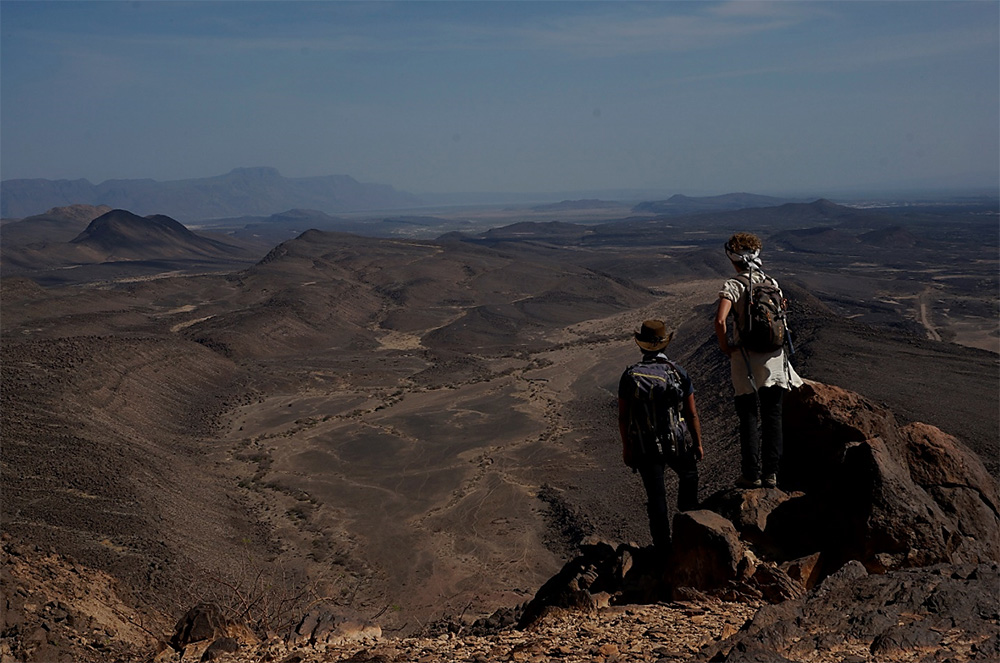
Vue sur les basaltes stratoïdes depuis un des nombreux volcans de l’Afar Central, Ethiopie. © Vapor-Afar, © E. Soteras.
Parcours
- 2022 – 2023 Fellowship at the Italian Academy for Advanced Studies, Columbia
- 2012 – 2015 Chargée de recherche – CNRS - UMR 5133 – Archéorient, Maison de l’Orient et de la Méditerranée, Université Lumière Lyon 2
- 2011 – 2012 Chercheure postdoctorale Juan de la Cierva, Departamento de Humanidades Institución Milà Y Fontanals (IMF), Consejo Superior de Investigaciones Científicas (CSIC), Barcelone, Espagne.
- 2011 Whittlesey Chair Visiting Assistant Professor, Chargée de cours au Department of History and Archaeology, American University of Beirut (AUB), Beyrouth, Liban.
- 2010 – 2011 Chercheure postdoctorale, projet archéologique du site de Gobero (République du Niger), Faculté de Biologie et Anatomie à l’Université de Chicago, Etats-Unis.
- 2009 – 2010 Chercheure associée au Centre Préhistoire, Antiquité, Moyen-âge (CEPAM), Université de Nice, Sophia-Antipolis CNRS, France.
- 2009 Distinguished Visiting Scholar à l’Université de Louisville, Kentucky – Faculté d’Anthropologie, Louisville, Etats-Unis.
- 2007 – 2008 Chercheure postdoctorale Fondation Fyssen au Centre d’Etudes Préhistoire, Antiquité, Moyen Age (CEPAM), Université de Nice, Sophia-Antipolis CNRS, France.
- 2004 – 2007 Chercheure associée au Centre Français d’Archéologie et de Sciences Sociales de Sanaa (CEFAS), Sanaa, Yémen.
- 2001 – 2006 PhD en archéologie (Université de Cambridge, Royaume Uni). Doctorat intitulé « Settlement, Culture-Contact and Interaction along the Red Sea Coastal Plain, Yemen: The Tihamah cultural landscape in the late prehistoric period (3000-900 BC) ». Directrice de thèse : A. McMahon. Membres du jury : G. Barker et T. J. Wilkinson.
- 1999-2001 M.Phil en archéologie (Université de Cambridge, Royaume Uni). Mémoire intitulé « Conquests as Myth : An Investigation of Akkadian Cultural Influence on Northern Mesopotamia ». Directrice de mémoire : A. McMahon.
- 1994-1998 Bachelor of Fine Arts (BFA) Université de Michigan, Ann Arbor (Ann Arbor, Etats-Unis).
- 1996-1997 Université de Dar-es-Salam, Tanzanie.
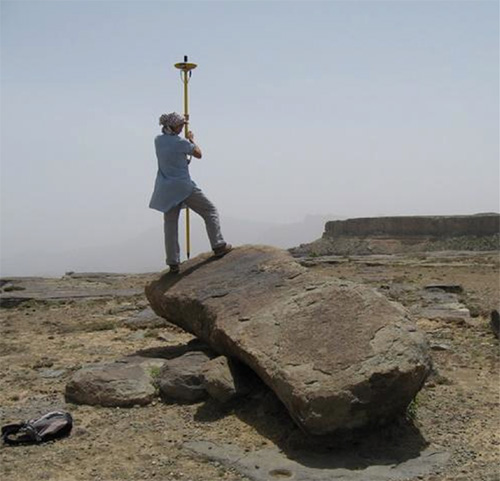
Le site de Masnaat Maryah dans les hauts plateaux yéménites en 2010. ©DSP
Problématique et démarche
La Corne de l’Afrique et l’Arabie de l’ouest appartiennent au système géologique du Grand Rift africain et se retrouvent en vis-à-vis, sur les bords de la Mer Rouge. Les activités volcaniques, de « rifting » et de soulèvement ont contribués à la formation des hautes chaines de montagnes atteignant des hauteurs entre 3 600 et 4 500 m de part et d’autre. Un volcanisme important et actif a produit des paysages accidentés qui hébergent des niches environnementales extrêmement variées des deux côtés. La diversité des contextes environnementaux et les ressources qu’ils fournissent ont créé des conditions propices à l’occupation humaine comme le montre le registre paléontologique humain de la région. Comme nos ancêtres lointains, les hommes modernes ont exploité ces paysages, s’adaptant aux périodes glaciaires en s’isolant dans les nombreuses niches écologiques.
Suite à un grand nombre d’années de recherches des deux côtés de la Mer Rouge (Yémen et la Corne de l’Afrique), et à l’accumulation d’une expérience de terrains et de contextes variés, il est devenu évident que des groupes humains ont toujours été résilients dans ces régions qu’ils ont occupées donc de façon continue notamment à l’Holocène, s’adaptant à des conditions difficiles. Leurs systèmes de mobilité bien adaptés (migrations humaines, pastoralisme puis réseaux d’échanges des biens) ont facilité cette résilience. Quant au Néolithique, il s’est développé dans ces régions plusieurs millénaires après le Proche Orient voisin, malgré les contacts déjà établis entre les régions. Mais nos connaissances sur la Néolithisation de la Corne de l’Afrique, comme ce même processus en Arabie, sont fragmentaires. Il existe moins d’une dizaine de sites en stratigraphie avec des dates fiables de chaque côté. La recherche de nouveaux terrains qui comblent ces grandes lacunes est donc indispensable pour mieux comprendre le processus de la Néolithisation dans des régions qui sont souvent considérées comme périphériques dans les phénomènes d’innovation. Ils sont pourtant devenus ensuite des acteurs et des centres économiques majeurs des plus importants réseaux d’échanges de l’Antiquité tels que le réseau maritime de Punt de l’Egypte pharaonique et le réseau d’échange caravanier de l’encens des royaumes sudarabiques.
Mes recherches interrogent les interactions « sociétés-milieux » dans le contexte du développement des premières sociétés de production, principalement durant les périodes de la Néolithisation et de l’établissement des premières sociétés proto-urbaines, au Moyen Orient et dans la Corne de l’Afrique. Mes recherches ont pour objectif d’étudier les dynamiques de contacts et d’échanges autour de la Mer Rouge et de la Péninsule Arabique et d’appréhender les liens qui existaient entre ces régions et le Moyen Orient d’une part, et l’Afrique du nord d’autre part.
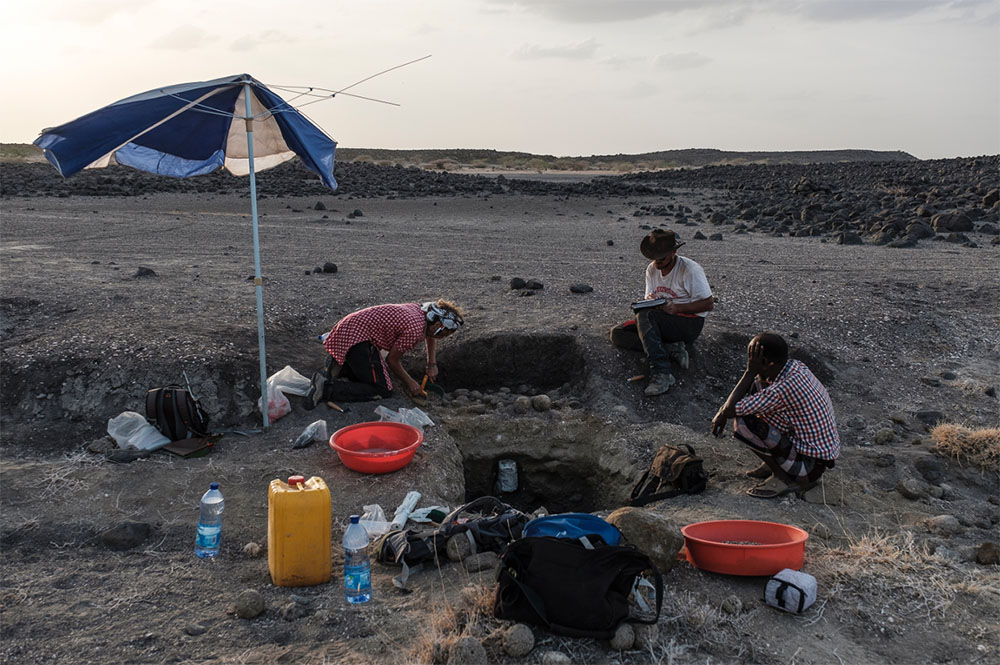
Fouilles du site LSA de Raso-02 dans l’Afar Central, Ethiopie. © Vapor-Afar, © E. Soteras.
Plus spécifiquement, j’aborde ces questions à travers la mise en place, l’évolution et la complexification des réseaux d’approvisionnement et d’échanges des productions d’obsidienne. C’est une excellente fenêtre d’entrée pour appréhender le phénomène de Néolithisation dans cette partie du globe, hautement dépendante des systèmes d’interactions qui se sont développés tout au long de l’Holocène. Missions archéologiques (prospections de gîtes naturels d’obsidiennes, de sites archéologiques et fouilles archéologiques), étude technologique des productions lithiques et géochimie du matériel en obsidienne (gîtologie, géochimie des sources et des artefacts, et formes sous lesquelles ces outillages circulaient) représentent le cœur de mes recherches fortement ancrées sur le terrain. A travers des collaborations multiples, les résultats de ces travaux sont intégrés et exploités selon des approches spatiales et modélisatrices qui permettent de mieux comprendre les dynamiques de mobilités, de contacts et de peuplements à large échelle.
Research interests and approaches
The Horn of Africa and western Arabia are part of the Great African Rift system and lie face to face on either side of the Red Sea. Volcanism, rifting and uplift are responsible for the formation of mountain ranges on both sides that reach heights between 3600 and 4500 m a.s.l. Massive active volcanism has created incised and undulating landscapes that host a large variety of environmental niches on either side. Just as the paleontological record demonstrates, the diversity of environmental contexts and the resources they provide have created ideal conditions for human occupation. Like our distant ancestors, modern humans exploited these landscapes, adapting to glacial periods by taking refuge in the numerous ecological niches dotting the region.
After a great number of years of research on both sides of the Red Sea (Yemen and the African Horn) and an accumulation of experience in the field and in a diversity of contexts, it has become evident that human groups have always been resilient in these regions which they continuously occupied – notably during the Holocene – adapting to difficult conditions. Their well-adapted forms of mobility (human migration, pastoralism and exchange) facilitated this resilience. As for the Neolithic, it was established in these regions several millennia after the neighboring Near East. However, our knowledge of the Neolithization of the Horn of Africa, like this same process in Arabia, remains fragmentary. There are fewer than a dozen well-dated stratified sites on either side of the Red Sea. The search for new sites and regions with potential to fill the large existing gaps is therefore indispensable to advancing knowledge on the process of Neolithization in the region. It is especially important as these regions are often considered peripheral to major human innovation phenomena despite the fact that they became economic centers and actors in the most important exchange networks in antiquity in the periods that followed, such as the maritime network linking Punt to pharaonic Egypt and the terrestrial incense trade caravan networks of the South Arabian kingdoms.
My research examines human-landscape interactions in the context of the development of the first production societies, principally during periods of Neolithization and of the establishment of the first proto-urban societies in the Middle East and in the Horn of Africa. My research focuses particularly on the study of the dynamics of contact and exchange around the Red Sea and the Arabian Peninsula and the links that existed between these regions, the Middle East and North Africa.
More specifically, I approach these questions by examining the introduction, evolution and complexification of obsidian supply and exchange networks. This approach is an excellent window into more comprehensive understanding of the phenomenon of Neolithization in this part of the world, which was heavily dependent on interaction networks that developed throughout the Holocene. My research, which is heavily anchored in fieldwork, is based on a multiplicity of approaches including archaeological fieldwork (geological survey of obsidian sources and archaeological survey and excavation), technological study of lithic production and geochemistry of obsidian (study of source and workshop contexts, sourcing of geological and archaeological obsidian and the form in which lithic industries and raw materials circulated). Through multiple collaborations, results of this work are integrated and exploited using spatial and modeling systems that allow simulation and thus a better large-scale understanding of the dynamics of mobility, contact and settlement.
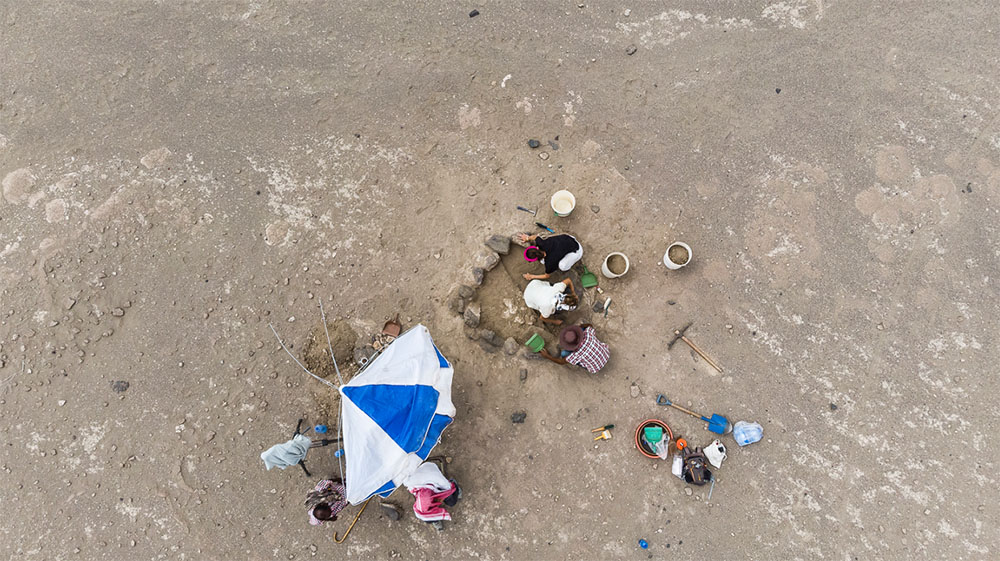
Fouilles du site LSA de Stromatolis dans l’Afar Central, Ethiopie. © Vapor-Afar, © E. Soteras.
Programmes de terrains actives
- Depuis 2014 : Direction du projet VAPOR-Afar, Ethiopie. Collaboration entre le CNRS, le CFEE, le Ethiopian Heritage Authority (EHA) et le Afar Bureau of Tourism and Culture (ABTC).
- 2017 - 2020 : AGXIM (Aléas géologiques, histoire du peuplement et transformations socio-économiques d’une zone lacustre au cœur de la dépression Afar (Ethiopie)) porté par C. Doubre (IPGS, UMR7516) et Eloi Ficquet (EHESS).
- Depuis 2015 : Mission archéologique de Kadruka, Soudan (Northern State). O. Langlois (CEPAM-CNRS) responsable de mission. L. Khalidi : chargée de l’étude du matériel lithique.
- Depuis 2014 : Premières Sociétés de Production dans la Corne de l’Afrique (PSPCA), Djibouti. J. Cauliez (TRACES-CNRS) : responsable de mission. L. Khalidi : chargée de prospection géologique.
- Depuis 2010 : Late Stone Age Sequence in Ethiopia. Bon (Université de Toulouse – le Mirail, UMR TRACES) et A. Dessie (ARCCH) : responsables de mission. L. Khalidi : chargée de prospection géologique et archéologique.
Programmes de terrains interrompus
- Direction du projet « VAPOR-Yemen », hauts-plateaux, Yémen.
- Direction du projet « Tihamah Coastal Survey », Tihamah, Yémen.
- Direction du projet « Hazm al-Udayn Survey », Escarpement, Yémen.
« Dhamar Survey Project », Dhamar, Yémen. Direction K. Lewis (UALR).
« Tell Brak Excavation », Syrie. Direction A. McMahon (Cambridge).
« Tell Hamoukar Excavation », Syrie. Direction C. Reichel (Toronto/ROM) et S. al-Quntar (U Penn). - « Tell Labwe sud », Liban. Direction M. Haidar-Boustani (MPL-USJ) et JJ Ibáñez (IMF-CSIC-Barcelone).
Programmes de recherche et collaborations
- 2021-2025 : ANR Nilafar The NILe and AFAR regions: hydrologic changes and impact on human adaptation in the last 20,000 years (ANR-20-CE03-0011-01). PI: M. Revel (Géoazur). Resp. du Archaeology Work Package : L. Khalidi.
- 2021 : Coretex Ceramic and Obsidian Research in the East African Rift: Territories and EXchange Agence Nationale de la Recherche « Investissements d’Avenir UCAJEDI n° ANR-15-IDEX-01 ». Co-PI : L. Khalidi & M. Gabriele (CEPAM).
- 2018-2020 : Climafar L'adaptation humaine face aux changements CLIMatiques dans les régions du Nil et de l'AFAR de 25,000 ans à aujourd’hui, Agence Nationale de la Recherche « Investissements d’Avenir UCAJEDI n° ANR-15-IDEX-01 ». PI : L. Khalidi (CEPAM) co-PI : M. Revel (Géoazur).
- 2017-2020 : TelluS AGXIM Aléas géologiques, histoire du peuplement et transformations socio-économiques d’une zone lacustre au cœur de la dépression Afar (Ethiopie). PI: C. Doubre (ITES, Strasbourg).
- 2014-2019 : ANR Big Dry Ruptures et continuité dans le peuplement de l’Afrique à la fin du Pléistocène : paléoanthropologie, paléoenvironnement et archéologies comparées du Rift et du Nil dans leur cadre continental (ANR-14-CE31-0023). PI: F. Bon (TRACES, Toulouse).
- 2014-2018 : ANR GeObs Géographie des obsidiennes d’Anatolie Orientale : sources caractérisation et diffusion aux époques préhistoriques (ANR-13-BSH3-0003). PI: D. Mouralis (IDEES, Rouen).
- 2011-2016 : Participation dans le Group 3 (PI : J.J. Ibañez – IMF-CSIC), Case Study 4 : “Exchange networks dynamics in early Near Eastern societies (Syria)” du projet intitulé Simulpast : simulating the past to understand human behaviour. PI : M. Madella (ICREA-IMF-CSIC)
Groupes de recherche et collaborations
- 2021-2023 : Cooperation Group: Volcanoes, Climate and History –VCH. ZIF (Center for Interdisciplinary Research), Bielefeld University. PI: Ulf Büntgen (Cambridge).
- 2020 – présent : GDR Rift : Groupe interdisciplinaire Grand Rift Africain. PI : C. Tiberi ; Co-resp. Groupe « Ressources naturelles – répartition et impact » : D. Barboni, V. Tallio, L. Khalidi.
Programmes patrimoine
- 2024-2027 : Aliph Museums in Yemen: Safeguarding and Archiving Museum Objects, Yemen. Co-PI : Khalidi (CEPAM-CNRS) and M. Abbes (CEFREPA).
- 2020-2021 : Aliph Covid 19 Emergency Grant for the rehabilitation of storerooms in five Yemeni Museums. Co-PI : I. Gerlach (DAI-Sanaa Branch), L. Khalidi (CEPAM-CNRS).
Comités, Conseils
- 2022-2023 Membre du Comité de Projet HCERES du CEPAM.
- 2020-2022 Membre élu du Comité éthique de l’International Association for Archaeological Research in Western & Central Asia (ARWA).
- 2019- Comité scientifique du GDR Rift : Groupe interdisciplinaire Grand Rift Africain
- 2018-2023 Membre élu du Conseil de Laboratoire du CEPAM
- 2018-2021 Membre nommé du Comité des Usagers du CEPAM
- 2018 Membre élu « Corresponding Member » de l’Institut Allemand d’Archéologie (DAI)
- 2014- Comité scientifique du Khalidi Library à Jérusalem.
- 2019- Conseil académique de la revue Zeitschrift für Orient-Archäologie (ZOrA) du Département Orient de l’Institut Allemand d’Archéologie.
- 2013- Comité éditorial du blog hebdomadaire Archéorient – Le Blog : environnements et sociétés de l’Orient ancien.
Encadrement Phd/ Postdocs
- 2022- O. Scancarello (Bourse doctoral de l’École Doctorale SHAL). Thèse de Doctorat intitulée « La production LIthique dans la CORNE de l’Afrique au cours de l’Holocène : origines, trajectoires et innovations des cultures et des sociétés préhistoriques (LICORNE) » Université Côte d’Azur, Nice (France). Co-direction : L. Khalidi et I. Théry – CEPAM, C. Lemorini – La Sapienza).
- 2022- T. Tarekegn Bayu (Bourse doctorale de l’Ambassade de France en Ethiopie). Thèse de Doctorat intitulée « Human-Environment Interactions During the Holocene: An Analysis of Archaeological Charcoals from Kumali Archaeological site; South-West Ethiopia » Université Côte d’Azur, Nice (France). Co-direction : I. Théry et L. Khalidi – CEPAM, A. Hoehn – Frankfurt).
- 2021-2022 C. Mologni. Post-doc sur projet ANR Nilafar en Géomorphologie, géoarchéologie dans le système hydrologique de l’Awash et le bassin du Lac Abhé (Rift et Afar Central, Ethiopie). CEPAM, Université Cote d’Azur, Nice (France). Co-direction : L. Khalidi (CEPAM) et L. Bruxelles (TRACES).
- 2017-2021 C. Mologni (Bourse doctoral d’Excellence Idex-UCA). Thèse de Doctorat intitulée The Role of Hydro-Climatic Changes on Paleolandscape Evolution and on Prehistoric Settlement During the Last Humid-Arid Cycle in the Horn of Africa. Co-direction : M. Revel (Géoazur), L. Khalidi (CEPAM).
Publications
https://www.researchgate.net/profile/Lamya-Khalidi
https://cnrs.academia.edu/LamyaKhalidi
Extrait de la production scientifique (HAL)
Types de document
24 publication(s) affichée(s) sur 46
Aucune publication ne correspond à ces filtres.
Articles dans une revue 11
-
Ulf Büntgen, Nicola Di Cosmo, Jan Esper, Michael Frachetti, Lamya Khalidi, et al.. Volcanoes, Climate, and Society. Annual Review of Earth and Planetary Sciences, 2025, ⟨10.1146/annurev-earth-032524-013254⟩. ⟨hal-05133578⟩
-
Carlo Mologni, Marie Revel, Eric Chaumillon, Emmanuel Malet, Thibault Coulombier, et al.. 50-year seasonal variability in East African droughts and floods recorded in central Afar lake sediments (Ethiopia) and their connections with the El Niño-Southern Oscillation. Climate of the Past, 2024, 20 (8), pp.1837-1860. ⟨10.5194/cp-20-1837-2024⟩. ⟨hal-04683781⟩
-
Joséphine Lesur, Jessie Cauliez, Lamya Khalidi, Laurent Bruxelles, Isabelle Crevecoeur, et al.. Preface. Séances de la Société préhistorique française, 2023, DU BIG DRY À L’HOLOCÈNE EN AFRIQUE DE L’EST ET AU-DELÀ / FROM THE BIG DRY TO THE HOLOCENE IN EASTERN AFRICA AND BEYOND. Actes de la Séance de la Société préhistorique française Toulouse, 25-28 septembre 2019, 20, pp.7-10. ⟨hal-04307829⟩
-
Louise Le Meillour, Antoine Zazzo, Séverine Zirah, Olivier Tombret, Véronique Barriel, et al.. The name of the game: palaeoproteomics and radiocarbon dates further refine the presence and dispersal of caprines in eastern and southern Africa. Royal Society Open Science, 2023, 10 (11), ⟨10.1098/rsos.231002⟩. ⟨hal-04301107⟩
-
Alice Leplongeon, Katja Douze, Behailu Habte, Lamya Khalidi, Clément Ménard, et al.. A Comparative Look at Technical Traditions in the Horn of Africa and the Nile Valley at the End of the Pleistocene. Séances de la Société préhistorique française, 2023, Dynamiques culturelles et transformation des paysages dans un continent en mutation : du Big Dry à l’Holocène dans l'Est africain, 20, pp.39-73. ⟨hal-04789331⟩
-
Michael Frachetti, Nicola Di Cosmo, Jan Esper, Lamya Khalidi, Franz Mauelshagen, et al.. The dahliagram: An interdisciplinary tool for investigation, visualization, and communication of past human-environmental interaction. Science Advances , 2023, 9 (47), ⟨10.1126/sciadv.adj3142⟩. ⟨hal-04304762⟩
-
Carlo Mologni, Marie Revel, Luc Bastian, Germain Bayon, Delphine Bosch, et al.. Enhanced continental weathering (δ7Li,εNd) during the rise of East African complex polities: an early large-scale anthropogenic forcing?. Comptes Rendus. Géoscience, 2022, 354 (G2), pp.319-337. ⟨10.5802/crgeos.169⟩. ⟨hal-03864320⟩
-
Hala Alarashi, Lionel Gourichon, Lamya Khalidi, Philippe Chambon, Pascal Sellier, et al.. Survival kit for the afterlife or instruction manual for prehistorians? Staging artefact production in Middle Neolithic cemetery Kadruka 23, Upper Nubia, Sudan. Antiquity, 2021, pp.e31 1-8. ⟨10.15184/aqy.2021.151⟩. ⟨halshs-03435129⟩
-
Lamya Khalidi, Carlo Mologni, Clément Ménard, Lucie Coudert, Marzia Gabriele, et al.. 9000 years of human lakeside adaptation in the Ethiopian Afar: Fisher-foragers and the first pastoralists in the Lake Abhe basin during the African Humid Period. Quaternary Science Reviews, 2020, 243, pp.106459. ⟨10.1016/j.quascirev.2020.106459⟩. ⟨hal-02911601⟩
-
Olivier Langlois, Gilles Durrenmath, Lamya Khalidi, Hisham Khidir Ahmed Karrar, Ahmed Karrar, et al.. Chronicle of a destruction foretold: a belated reassessment of the preservation status of Neolithic habitation sites in the Kadruka concession (Northern Dongola Reach, Sudan). Sudan & Nubia, 2019, 23, pp.61-67. ⟨halshs-02975342⟩
-
Clive Oppenheimer, Lamya Khalidi, Bernard Gratuze, Nels A Iverson, Christine S Lane, et al.. Risk and reward: explosive eruptions and obsidian lithic resource at Nabro volcano (Eritrea). Quaternary Science Reviews, 2019, 226, pp.105995. ⟨10.1016/j.quascirev.2019.105995⟩. ⟨hal-02308575⟩
Ouvrages 3
-
Jessie Cauliez, Xavier Gutherz, H. Alarashi, Laurent Bruxelles, Lucie Coudert, et al. (Dir.). Djibouti. Des Paysages & des Hommes. Regards sur le patrimoine archéologique du Lac Abhé. Préface d’Yves Coppens. CERD Centre d'Etudes et de Recherches. Editions du CERD, 215 p., 2021. ⟨hal-03381725⟩
-
Christian Darles, Lamya Khalidi, Mounir Arbach. Contacts between South Arabia and the Horn of Africa, from the Bronze Age to Islam. Presses universitaires du midi, 2021, Série Sites et Cités d'Afrique, François Bon, 978-2-8107-0726-3. ⟨hal-02379795⟩
-
Lamya Khalidi, Mounir Arbach, Marylène Barret-Audouin. Hommage à Rémy Audouin. Editions CEFAS, 2020, 978-2-909194-34-9. ⟨hal-03091745⟩
Chapitres d'ouvrage 9
-
Azza Ali Aqil, Marylène Barret-Audouin, Lamya Khalidi, Jérémie Schiettecatte. A Unique Heritage in Turmoil. Ann Blanchet; Marianne Cotty; Juliette Honvault. Aden, Marseille - D’un port à l’autre entre Arabie et Méditerranée, Centre de la Vieille Charité; Silvana, pp.216-231, 2026, 9788836662548. ⟨halshs-05466449⟩
-
Joséphine Lesur, Jessie Cauliez, Lamya Khalidi, Laurent Bruxelles, Isabelle Crevecoeur, et al.. From the Big Dry to the Holocene in Eastern Africa and beyond. Foreword. Joséphine Lesur; Jessie Cauliez; Lamya Khalidi; Laurent Bruxelles; Isabelle Crèvecoeur; David Pleurdeau; Chantal Tribolo; François Bon. Du Big Dry à l’Holocène en Afrique de l’Est et au-delà / From the Big Dry to the Holocene in Eastern Africa and beyond, 20, Société Préhistorique Française, pp.11-12, 2023, Séances de la Société Préhistorique Française. ⟨hal-04789421⟩
-
Lamya Khalidi, Marylène Barret-Audouin. Yémen : Un fleuron du patrimoine mondial saccagé par la guerre. Atlas des sites archéologiques menacés : Patrimoine à protéger, CNRS le cherche midi, pp.68-71, 2023, 9782749177052. ⟨hal-04301100⟩
-
Eloi Ficquet, Cécile Doubre, Lamya Khalidi. Monticules funéraires et grammaire des pierres dans le pays afar. Boisserie J.-R.; Prat S.; Tiberi C. Le Grand Rift Africain - à la confluence des temps, Cherche-Midi; CNRS, pp.24-25, 2023, 978-2-7491-7814-1. ⟨hal-04503562⟩
-
Alice Leplongeon, Katja Douze, Behailu Habte, Lamya Khalidi, Clément Ménard, et al.. A Comparative Look at Technical Traditions in the Horn of Africa and the Nile Valley at the End of the Pleistocene. J. Lesur, J. Cauliez, L. Khalidi, L. Bruxelles, I. Crevecoeur, D. Pleurdeau, Ch. Tribolo et F. Bon. Du Big Dry à l’Holocène en Afrique de l’Est et au-delà, 20, Société Préhistorique Française, pp.39-74, 2023. ⟨hal-04840322⟩
-
Lamya Khalidi, Doris Barboni, Joséphine Lesur, Susan Onyango, Virginie Tallio, et al.. Une exploitation des ressources dans le temps et l'espace. Jean-Renaud Boisserie; Séverine Prat; Christel Tiberi. Le Grand Rift Africain: A la confluence des Temps, Cherche-Midi CNRS, pp.102-111, 2023, 978-2749178141. ⟨hal-04987722⟩
-
Doris Barboni, Jean-Renaud Boisserie, Jessie Cauliez, Isabelle Crevecoeur, Lamya Khalidi. Les humains face au Rift. Le grand Rift africain : à la confluence des temps, CNRS le cherche midi, pp.100-137, 2023, 978-2749178141. ⟨hal-04301117⟩
-
Jessie Cauliez, Stéphane Hérouin, Xavier Gutherz, Asma Youssouf Aden, Hala Alarashi, et al.. Monumentalisme funéraire et premières sociétés de production dans la Corne de l’Afrique. Le monument à double couronne d’Antakari 3 en République de Djibouti (région d’As Eyla,District de Dikhil). Vincent Ard; Emmanuel Mens; Muriel Gandelin. Mégalithismes et monumentalismes funéraires : passé, présent, futur, Sidestone Press, pp.319-352, 2021, 978-90-8890-989-4. ⟨hal-03427238⟩
-
Lamya Khalidi, Mounir Arbach. Préface. Lamya Khalidi; Mounir Arbach; Marylène Barret-Audouin. Hommage à Rémy Audouin. À l'occasion des 21e Rencontres sabéennes [Toulouse, 8-10 Juin 2017], Centre Français d'Archéologie et de Sciences Sociales (CEFAS), pp.16-17, 2020, 978-2-909194-34-9. ⟨hal-02379799⟩
Numéros spéciaux de revue 1
-
Joséphine Lesur, Jessie Cauliez, Lamya Khalidi, Laurent Bruxelles, Isabelle Crevecoeur, et al.. From the Big Dry to the Holocene in Eastern Africa and beyond. Séances de la Société préhistorique française, 20, 157 p., 2023. ⟨hal-04789406⟩
Communications sans actes 16
-
Olivier Langlois, Gilles Durrenmath, Aline Emery-Barbier, Hisham Khidir Ahmed Karrar, Hassimi Sambo, et al.. Neolithic and Pre-Kerma settlements at Kadruka (Sudan): characteristics, contributions, potentials. 27th Biennial Meeting of the Society of Africanist Archaeologists (SAfA 2025), Session 39 (Investigating settlements vs cemeteries: Competing or complementing interests? A view from Sudan), SAfA, Jul 2025, Faro, Portugal. ⟨hal-05355728⟩
-
Jessie Cauliez, Carlo Mologni, Marie Revel, Isabelle Crevecoeur, Laura Maréchal, et al.. Ecological Stress, Adaptation & Innovation: Hunter-Gatherers to Early Farmers in the Horn of Africa. in 27th Biennal Meeting: African Archeology, SAFA Society of Africanist Archaeologists, Cross Roads Trough Time, Session 18. Climate Change and Human Responses in Past African Societies: Lessons for a Changing World (July, 2025)., 2025, Algarve, Portugal. ⟨hal-05288980⟩
-
Olivier Langlois, Gilles Durrenmath, Hisham Khidir Ahmed Karrar, Sambo Hassimi, Lamya Khalidi. Une archéologie de sauvetage sur des habitats tardivement (re)découverts. Séminaire du Master STPE, Parcours PPA, Unica « Recherches à Kadruka (Soudan). Un espace clé (mais menacé) pour la connaissance de la Préhistoire récente de la Haute-Nubie », Oct 2023, MSHS Sud-Est, Université Côte d’Azur, Campus Saint-Jean d’Angély, Nice, France. ⟨hal-05592183⟩
-
Marie Revel, Carlo Mologni, Eric Chaumillon, Emmanuel Malet, Bernard Fanget, et al.. Variability in seasonal East African droughts and flood magnitudes recorded in Central Afar lakes sediments (Ethiopia and Djibouti) and their connections with ENSO. Réunion des Sciences de la Terre (RST) 2023, 28ème édition, 2023, Rennes, France. ⟨hal-04310203⟩
-
Jessie Cauliez, Abdoulkader Mariam, Hala Alarashi, Laurent Bruxelles, Lucie Coudert, et al.. Climatic variations in the Lake Abhe area since the end of the Pleistocene (Djibouti): the transition from the last hunter-gatherers-fishers to the first herders in the Horn of Africa and their resiliency. Climatic change research summit : un chemin vers l’adaptation et la resilience, Inauguration de l’Observatoire Régional de Recherche pour l’Environnement et le Climat, ORREC Djibouti, Oct 2022, Djibouti, Djibouti. ⟨hal-04056122⟩
-
Carlo Mologni, Laurent Bruxelles, Mathieu Schuster, Isabelle Couchoud, Véronique Michel, et al.. Past microbial activity as an overlooked tracer of hydro-climatic changes in the East African Rift System: the case of the microbialites of paleo-lake Abhe (Ethiopia, Djibouti). 18ème congrès Français de Sédimentologie, Sep 2022, Brest, France. ⟨hal-04056153⟩
-
Carlo Mologni, Marie Revel, Lamya Khalidi, Laurent Bruxelles, Mathieu Schuster, et al.. Climate-controlled East African fluvial and lacustrine geomorphic systems during the Holocene: the cases of the Blue Nile River and Lake Abhe (Ethiopia & Djibouti). Colloque Q13 sur le Quaternaire, Mar 2022, Strasbourg, France. ⟨hal-04056198⟩
-
Olivier Langlois, Gilles Durrenmath, Hisham K. A. Karrar, Sambo Hassimi, Lamya Khalidi. The 4th millennium BC gap in the Northern Dongola Reach sequence: a false gap to fill?. 15th International Conference for Nubian Studies, Aug 2022, Varsovie, Poland. ⟨halshs-03811632⟩
-
Carlo Mologni, Marie Revel, Lamya Khalidi, Jessie Cauliez, Laurent Bruxelles, et al.. The impact of the Holocene monsoonal regimes on East African fluvial and lacustrine geomorphic systems: the cases of the Blue Nile River and the Lake Abhe. Climat et Impacts 2022, Nov 2022, Paris, France. ⟨hal-04056039⟩
-
Olivier Langlois, Gilles Durrenmath, Hisham Khidir Ahmed Karrar, Hassimi Sambo, Lamya Khalidi. Le "hiatus du 4e millénaire BCE" dans la séquence du Northern Dongola Reach (Soudan) : réalité ou résultat d'une combinaison de facteurs propices à la création de lacunes chronologiques ?. 29e Congrès Préhistorique de France. Hiatus, lacunes et absences : identifier et interpréter les vides archéologiques, May 2021, Toulouse, France. ⟨hal-03368023⟩
-
Stéphane Hérouin, Marie Matu, Hala Alarashi, Lucie Coudert, Laurent Bruxelles, et al.. Funérailles et monumentalisme : stratégie(s) sociale(s) face à la mort des Néolithiques du bassin du Gobaad (République de Djibouti). 12ème Rencontre annuelle du Gaaf 2020 (Groupe d’anthropologie et d’archéologie funéraire). Rencontre autour des funérailles. Des os et des larmes : préparer les corps, pleurer et honorer les morts, May 2021, Chartres, France. ⟨hal-03452760⟩
-
Clément Ménard, Lucie Coudert, Stéphanie Roussel, Joséphine Lesur, Lorène Chesnaux, et al.. Shifts in subsistence strategies and material culture at the onset of the Holocene in the Ziway-Shala Basin, Main Ethiopian Rift. 25th Biennal Meeting of the Society of Africanist Archeologists (SAfA) : African Archaeology — A 20:20 Vision for the Future, Aug 2021, Oxford, United Kingdom. ⟨hal-03427265⟩
-
Carlo Mologni, Laurent Bruxelles, Fabien Arnaud, Pierre Sabatier, Anne-Lise Develle, et al.. Hydro-climatic causes and environmental consequences of the Lake Abhe drying (Ethiopia & Djibouti): a lesson from the past 10,000 years. vEGU21, the 23rd EGU General Assembly, Apr 2021, Online, Austria. ⟨10.5194/egusphere-egu21-4634⟩. ⟨hal-03452797⟩
-
Lamya Khalidi, Carlo Mologni, Clément Ménard, Lucie Coudert, Gourguen Davtian, et al.. Human adaptation in the Lake Abhe Basin (Ethiopian Afar) during the Early to Middle Holocene African Humid Period. 25th Biennal Meeting of the Society of Africanist Archeologists (SAfA) : African Archaeology — A 20:20 Vision for the Future, Aug 2021, Oxford, United Kingdom. ⟨hal-03427262⟩
-
Carlo Mologni, Marie Revel, Lamya Khalidi, Laurent Bruxelles, Mathieu Schuster, et al.. The impact of the Holocene monsoonal regimes on East African fluvial and lacustrine geomorphic systems: the cases of the Blue Nile River and the Lake Abhe. Climat et Impacts 2020, Nov 2020, Paris, France. ⟨hal-04056212⟩
-
Carlo Mologni, Lamya Khalidi, Marie Revel, Laurent Bruxelles, Jessie Cauliez, et al.. Climate change and human lakeside adaptation in the Central Afar Region (Lake Abhe basin, Ethiopia & Djibouti) during the Later Stone Age - Neolithic transition: a multi-scalar and multi-proxy approach. 22nd EGU General Assembly, held online, May 2020, Online, Austria. ⟨10.5194/egusphere-egu2020-10806⟩. ⟨hal-03452812⟩
Posters 1
-
Olivier Scancarello, Lamya Khalidi. 1000 years of mid-late Holocene lithic technical traditions from two Neolithic sites in the Central Afar (Ethiopia, ca. 4.3-3.3 ka). 9th biennial conference of the Eastern African Association for Palaeoanthropology and Palaeontology (EAAPP), Jul 2024, Addis Ababa, Ethiopia. Unpublished, 2024, ⟨10.13140/RG.2.2.19536.52483⟩. ⟨hal-05726088⟩
Recueils de communications 1
-
Doris Barboni, Guillaume Blanc, Jean-Renaud Boisserie, Didier Bompangue, Marie Bridonneau, et al.. Great African Rift Interdisciplinary Research Group 2022 Scientific meeting. GDR Rift second Colloquium 2022, Nov 2022, Lyon, France. 2022. ⟨hal-03891535v2⟩
Rapports 1
-
Lamya Khalidi, Laurent Bruxelles, Jessie Cauliez, Lorène Chesnaux, Gourguen Davtian, et al.. Final report. Volcanological & Archaeological Program for Obsidian Research – Afar Ethiopia. [Research Report] UMR 7264 CEPAM (Université Nice Sophia-Antipolis). 2016. ⟨hal-01992985⟩
Articles de blog scientifique 3
-
Lamya Khalidi. Destruction of Cultural Heritage in Yemen: 2015 to the present. 2023. ⟨hal-04301835⟩
-
Lamya Khalidi. The evolution of Lake Abhe’s paleoshorelines reveals 9000 years of human resilience in the face of climate change. 2020. ⟨halshs-03093485⟩
-
Cécile Doubre, Lamya Khalidi, Eloi Ficquet. Busy and interdisciplinary in the Afar: the AGXIM Project. 2018. ⟨hal-03997813⟩